SHARE 2012 SpecTIR imagery
Direct directory of ENVI .hdr + .img reflectance cubes. Individual images range from about 951 MiB to 13 GiB.
Local scientific raster viewer
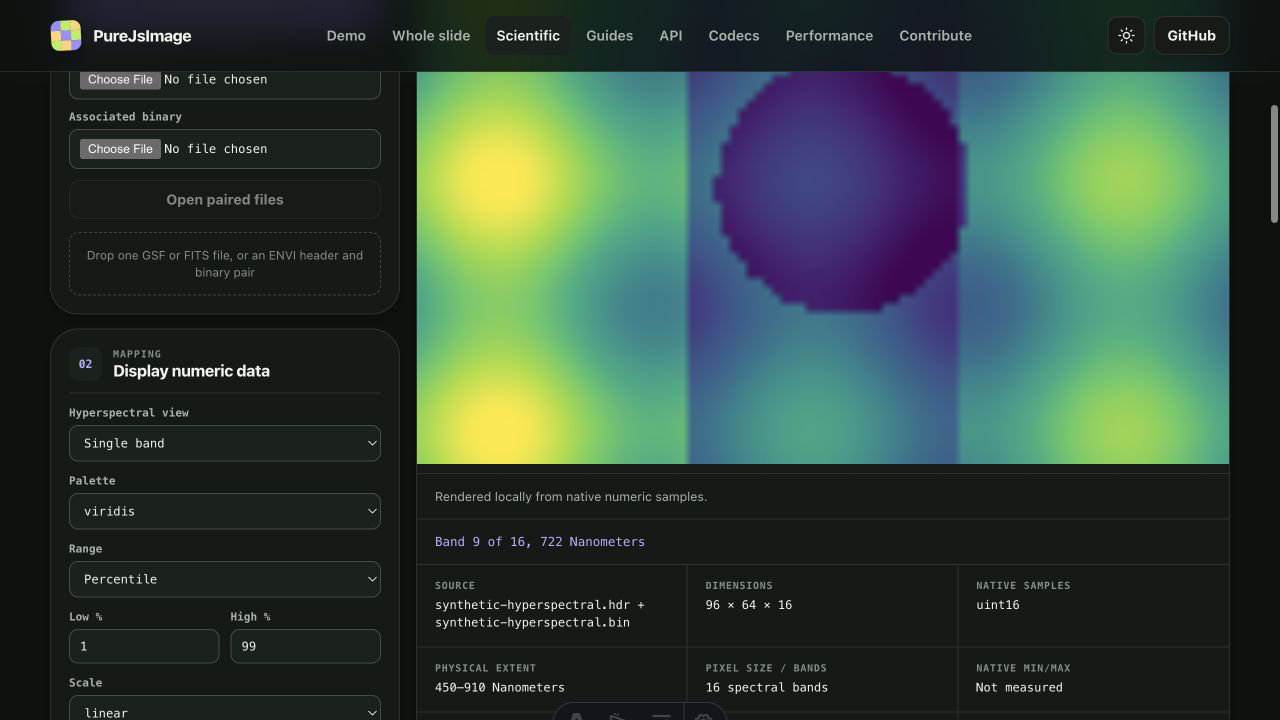
PureJsImage keeps numeric samples separate from the RGB pixels used for display. Range selection, palettes, display transfers, and relief are explicit operations.
Ready.
Quantitative source values remain unchanged. Palette, stretch, scale, and relief affect only the streamed display pixels shown above.
The PNG is the current display rendering, not a converted scientific dataset.
Real public data
These university and U.S. government collections publish ENVI header + binary pairs and FITS image arrays. Large files should be downloaded before opening them above.
Direct directory of ENVI .hdr + .img reflectance cubes. Individual images range from about 951 MiB to 13 GiB.
The FITS Support Office publishes image, table, and conformance samples for testing FITS readers.
Browse NASA FITS samples ↗Five complete imaging-spectrometer products covering vegetation, cities, geology, calibration, and high-resolution data.
Browse free AVIRIS data ↗Cataloged ENVI .hdr + .bin products with 224 bands from roughly 400–2500 nm. Earthdata sign-in may be required.
ENVI .hdr + .dat flight scenes with 256 thermal-infrared bands from 7.5–12 µm.
Skip the catalog
FITS examples are single-file downloads. For a paired ENVI example, download both numbered files and select them together above.
304 × 251 × 85 · float32 · BIL · 24.7 MiB binary
0920-1701_pol_ref_geo · ENVI image · 951 MiB binary
132 MiB ZIP containing the matching ENVI header and binary map files.
100 × 100 · float32 · primary image · 61.9 KiB
512 × 512 · scaled int16 · primary image · 526 KiB
831 × 110 · two scaled int16 image HDUs · 379.7 KiB
Open a FITS download: choose FITS image arrays, then select the downloaded file under FITS file. Open an ENVI download: unpack the archive, choose its .hdr file under ENVI header, choose the matching .img, .bin, or .dat file under Associated binary, then click Open paired files. A browser may save a header as .hdr.txt; the explorer accepts that filename too. GSF is commonly exported from AFM/SPM software rather than distributed by institutional archives.
Scientific raster formats
GSF, ENVI, and FITS remain scientific datasets rather than photographic codecs. Their numeric samples use the same dataset API as OME-TIFF planes.